Sunday, January 18, 2015

"Pensatas de domingo", o trem da Eurásia, as decadências do dólar e do império estadunidense


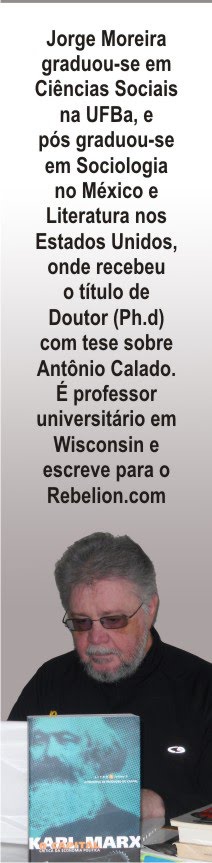
Esta “Pensata de domingo” foi brilhantemente escrita por Jorge Vital de Brito Moreira, nos trazendo notícias que a mídia burguesa brasileira nos omitiu...

Vivendo fora do Brasil, me comunico frequentemente com os amigos e os familiares através de telefonemas internacionais, de e-mails e  do uso do Skype. Frequentemente, no nosso diálogo, notamos que algumas noticias internacionais não estão sendo divulgadas pela mídia corporativa, pelos meios de informação/desinformação brasileiros.
Recentemente enviei um e-mail (vejam em seguida) para alguns amigos brasileiros referindo-me a conclusão da mais longa viagem de trem, na maior locomotiva, na mais extensa linha de ferro da história da humanidade. Aqui está o e-mail.  
 Caros amigos,
Esta locomotiva é um gigantesco empreendimento (e sinal)  da nova realidade material global da “Eurásia” (China, Rússia, Índia, Iran, Turquia e Europa): uma realidade que o imperialismo dos EUA não quer aceitar e que nos poderá conduzir à uma terceira (a última e definitiva) guerra nuclear (via invasão da Ucrânia ou da Coreia do Norte). Vejam a noticia no jornal televisivo da Telesur no link:
 https://www.youtube.com/watch?v=ouDE6Lth4OI
Como os leitores poderão deduzir,  minha intenção era iniciar um dialogo com os amigos sobre o significado e o sentido deste novo empreendimento material na nossa historia contemporânea.  Mas fiquei surpreendido quando meus amigos me comunicaram que não tinham visto essa noticia na televisão, nem lido nos jornais, nem escutado nas rádios, ou nos seus computadores pela internet.
Dado que li e vi essa noticia nos meios informativos  europeus (de língua inglesa, The Guardian, The Telegraph e de língua espanhola, El País) e América Latina (Telesur), voltei ao computador e fui procurar pela informação nos websites de jornais e revistas brasileiras. Lamento ter de revelar que, depois de uma hora procurando a noticia, não a encontrei em nenhum meio de informação/desinformação do Brasil.
Assim, darei aos leitores de Novas Pensatas algumas informações básicas sobre um acontecimento que poderá ser, neste ano de 2015, um fator sumamente importante para o estabelecimento de um novo mundo (futuro): um mundo multipolar, regido por relações multiculturais, num sentido verdadeiramente democrático da palavra.
Aqui estão às notícias: o jornal televisivo Telesur informou que o trem chinês transportou 82 vagões cheio de mercadorias (das simples mercadorias aos sofisticados carros de luxo) que pesavam mais de 1.400 toneladas. Telesur também informou que o trem Eurásico percorreu mais de 13.000 quilômetros durante 21 dias. Telesur também informou que a Alemanha já introduziu as necessárias mudanças no seu sistema financeiro internacional para que o intercâmbio comercial entre Europa e China seja realizado diretamente entre a moeda chinesa e o Euro (a moeda europeia) sem a mediação do dólar estadunidense.
A notícia do jornal El País, intitulada  “O trem ‘Yixinou’ abre uma linha direta de mercadorias entre China e Espanha” descreve os dados financeiros do intercâmbio econômico destacando as futuras vantagens comerciais e ecológicas para os dois países proporcionadas pelo gigantesco empreendimento.
O jornal The Guardian destaca a chegada na cidade de Madrid, capital da  Espanha, do gigantesco trem, depois da viagem "épica", que é a primeira ligação direta entre a China e a Espanha. A noticia intitulada “A ferrovia de seda: trem de carga da China puxa pra cima o astral em Madrid”, enfatiza que o prefeito da capital espanhola e ministro do desenvolvimento espanhol recebeu o comboio ferroviário que inaugurou a rota mais longa do mundo de 8.111 milhas. A noticia explica que o trem partiu da cidade chinesa de Yiwu e cruzou os seguintes países: o Cazaquistão, a Rússia, a Bielorrússia, a Polônia, a Alemanha e a França antes de chegar no terminal de cargas na cidade de Abroñigal, na Espanha.
 O jornal The Telegraph observa que o teste desta longuíssima viagem foi bem sucedido, abrindo a possibilidade de uma rota regular entre a China e a Espanha, em 2015. No artigo intitulado “A mais longa viagem de trem do mundo termina em Madrid”, o jornal enfatiza que o comboio que deixou Yiwu no leste China em 18 de novembro concluiu sua viagem em Madrid, 20 dias mais tarde. Indica que “a rota da seda” China-Madrid foi concebida como um teste para ver se é viável e pode agora abrir uma linha de carga normal no próximo ano. Assim, a nova rota China-Madrid iria aumentar significativamente o comércio mundial  entre o oriente/ocidente pois de acordo com os dados atuais, 80% deste comércio, tem circulado por via marítima devido as dificuldades de serviços ferroviários existentes.
Espero que as informações mencionadas possam ajudar o leitor a questionar e a buscar as razões porque a mídia corporativa do Brasil e dos EUA não querem informar sobre a nova rota de trem China-Madrid. Nem quer informar sobre como a existência da aliança Eurásica contribui para acelerar a decadência da hegemonia do dólar ianque, do Fundo Monetário Internacional (FMI), do Banco Mundial e do Federal Reserve Bank, os pilares financeiros fundamentais da ditadura do Imperialismo dos EUA sobre o resto do mundo.
Em resumo, diante desta nova realidade, desejo para o ano de 2015 que os homens de boa vontade ajudem a promover o desenvolvimento de um mundo multipolar, multicultural e melhor para a humanidade: um mundo que tenha o poder de expulsar o domínio unidimensional, ditatorial, tirânico e terrorista do imperialismo dos EUA sobre os povos e as nações pobres do planeta terra. 
Fonte:  http://novaspensatas.blogspot.com

Saturday, August 2, 2014

André Setaro


-->
Portraits of Memory of the Brazilian Film Critic André Setaro

I met my friend, André Setaro for the first in 1967 during the shooting of the short film "Perâmbulo" (“Wanderer”), a clever short film authored by young filmmakers and friends, José Umberto and José Carlos Menezes. We were a group of young people - friends and acquaintances interested in film and music - meeting at a restaurant next to the Castro Alves Theater off Campo Grande Square (in Salvador, Bahia, Brazil). We were seated at the tables of the restaurant "to have lunch", I mean, to act and perform as extras for scenes shot for the short film. André Setaro, at that time, was a young guy, thin, tall, pale and almost shy.
 If my memory serves me well, I met André for the second time in front of the College of Philosophy and Human Sciences at the Federal University of Bahia (UFBa), located in the neighborhood of Nazareth, in Salvador. At that time, José (Zé) Umberto, Chico Sampaio, other dear friends, and I had begun to study Social Sciences (Sociology) in the College of Philosophy. André, a few years younger than we were, was still preparing to enter Law School. Years later, he completed his Law degree, but he never practiced law. One of my recurring memories of André at that time is seeing him walking in front of the College of Philosophy, often accompanied by a black umbrella that he carried in his right hand.
While we studied Social Sciences, my friend Zé Umberto also deepened his knowledge of the art of cinema, as I studied cello and music composition in the Seminário de Música (Music Seminars) at the UFBa. At a certain point in our university journey, Zé decided to produce and direct his first feature film, O Anjo Negro (The Dark Angel), inviting me to compose the music for the song "I'm alone", a poem he had written, which read:
“Estou só        Cada vez mais estou só            Meu barco não navega no mar
Meu aeroplano na linda galáxia não sabe voar          Cada vez mais estou só”
(I'm alone       I am increasingly alone         My boat does not sail at sea
My airplane does not fly in the beautiful galaxy     and     I am increasingly alone).
It goes without saying that Zé’s invitation to work on the creation of a sound track pleased me immensely. 
For students of Sociology, his film O Anjo Negro, also helped us see Brazilian society as a complex whole of social relationships between different social classes, different races and ethnicities, different sexual genders, different nationalities and different generations. 
As a student of Social Sciences, I also learned, from my undergraduate classes, how the existence of the military dictatorship with its policy of repression, torture, and the murder of Brazilian citizens, was a threat, not only to our middle class socio-economic-cultural position, but also to that of most of the population of Brazilian society. At that time, all the contradictions and political, social, economic and cultural conflicts between social classes, races, genders, and between old and new generations tended to face a decisive confrontation in favor of the birth of a new society in Brazil.  However, the Brazilian military dictatorship emerged in Brazilian society to (violently, oppressively, and criminally) suppress the differences and contradictions within our social history. 
After graduating in Social Sciences, I tried to get a job as a professional expert in Sociology, but I was never able to find work as a sociologist in the city of Salvador, because at that time, the military rulers did not allow me to do it. From the standpoint of the ideology of the dictatorship, Sociology was a useless and/or subversive career. I had no alternative but to start working as a journalist in the well-known Bahian newspaper, Tribuna da Bahia, in the city of Salvador.
Years later, I left the Tribuna da Bahia and went to work in the Amazon forest, because it was the only place where I could get a job as a professional sociologist. 

It was during this point (since 1974) that André Setaro started to develop himself as a professional film columnist and critic for the Tribuna da Bahia. For 40 years, he wrote reviews of great analytical and critical quality on important movies and became one of the most important film critics of Bahia and Brazil.

 I lost almost all contact with André Setaro, Zé Umberto José Carlos Menezes, Edgard Navarro and other friends connected to Bahian cinema during the years I was working as a rural sociologist in the state of Rondônia (in the Amazon forest), in the state of Pernambuco and Bahia, on the bank of the São Francisco River, areas flooded by the dam of the CHESF in Sobradinho.
 
That distance between these friends and I increased when I emigrated to study (a Masters degree in Mexico and a Ph.D. degree in the U.S.) and started working and living abroad. Even traveling sporadically (during holidays) to the city of Salvador to visit my family, relatives, and friends, I never had the opportunity to contact André.
 
In 2008, I traveled to Brazil to launch (in Salvador, Feira de Santana and Lenclos) my book, Memorial da Ilha e Outras Ficções (Memorial of the Island and Other Fictions), a volume consisting of a short novel about summer vacations on Itaparica Island (in Bahia) and some short stories about the period of the darkest years of the military dictatorship (“the years of lead”). It was during this visit in 2008, that a great friend of mine, the filmmaker Edgard Reis Navarro Filho, told me that Rex Schindler and his group had caused great harm to the new film, “Revoada” (The last flight of the flocks) by the director, Zé Umberto and informed me about the serious neglect of Bahian filmmakers: they were unable to step up to defend the director, Zé Humberto. But the critic, André Setaro, was one of a few film critics who had the courage to face Rex Schindler’s group and write almost daily in defense of director and author, José Umberto Dias.

The lack of solidarity, the indifference and cowardice of the Bahian cinema group to support and defend Zé Umberto also made me angry and I decided to write a letter addressed to André Setaro, supporting his work and his fight to expose the absurd situation with Revoada. After receiving my letter, André Setaro decided to publish it in his Setaro's blog with the title “A questão ‘Revoada’ vista de fora do Brasil” ("The 'Flock' issue seen from outside of Brazil ") because I was living and working in the USA at the time.

In the introduction to my letter, André wrote: “Recebi de Jorge Vital, que conheci, quando a Bahia era a Bahia e não a cidade engarrafada, congestionada e enfartada dos tempos atuais, esta mensagem que coloca bem a questão Revoada, principalmente por um estudioso que mora há algum tempo nos Estados Unidos. Vital acompanhou todo o imbróglio por este blog e pelas publicações do espaço virtual que deram conta do terrível castigo imposto a um cineasta idealista como José Umberto.” (I received from Jorge Vital - whom I met when Bahia was Bahia and it was not the bottled-necked, congested and infarcted city of modern times - this message that lays out well the issue of Revoada, especially in that it is coming from an expert who has been living in the US for some time. Vital accompanied the whole imbroglio by way of this blog and through the publications of this virtual space that inform about the terrible punishment imposed on an idealistic filmmaker such as Jose Umberto.)

After he published this letter of mine, we talked often via international phone calls about the situation of Zé’s film and many other topics, including predominantly film (American, European, and Brazilian movies), the situation of mediocrity and social-economic-political-cultural poverty in the state of Bahia and Brazil, the decline of national public health services, and the state of our own personal health.     

When I informed André that I was writing about social, economic, cultural, film and musical themes in Spanish for Rebelion.org, he asked me if I was interested in writing a text on Brazilian or International film to be placed in his Setaro's blog. I accepted his invitation and my first collaboration was titled "Capitalism: A Love Story by Michael Moore”. This text was the translation into Portuguese of my text originally written and published in Spanish by Rebelion.org. From that moment on, I never stopped my collaboration with Setaro's blog, with written texts in Portuguese or those translated from Spanish.   

Later, André introduced me (by e-mail) to the editor of the blog, Novas Pensatas, the creative artist, Jonga de Olivieri, who besides being a recognized professional in the field of advertising, is also a lucid writer as well as a dear cousin of Setaro. To my surprise and joy, Jonga invited me to collaborate in writing for the blog, Novas Pensatas. I accepted his invitation and even now, I continue collaborating with Novas Pensatas blog, and enjoy the friendship and generosity of Jonga and his family.

Over the years, I developed a warm admiration for André’s work, for his knowledge of film art, for the openness and depth with which he prepared his articles on film for his column in the Tribuna da Bahia, for his Setaro’s blog, and for Terra Magazine online journal.

 With the passage of time, we reduced the distance of our relationship and as our mutual knowledge of each other grew, so did my admiration for him: I admired his courage and his indignation when he spoke of the predominant characteristics (chaos, violence, and degradation) that assault our modern city of Salvador (our beloved homeland); for his understanding and generosity to those filmmakers who depended on public calls (edital publicos) to undertake their films; for his indignation against mediocrity and the commercialism of cinematographic authorities linked to the Brazilian and Bahian government and the majority of film production; for his revolt against the high interest rates imposed by the capitalist banks against the Brazilian and Bahian population.

It was gratifying to see his strength in defending his points of view; it was encouraging to see his “Machado de Assis kind of irony” and political resistance to gentrification (of broad sectors of the middle class) arising from the socio-economic-ideological reality of 21 years of military dictatorship, of liberal/populist discourses and of national myths such as “the Brazilian people are welcoming (cordial) and free from racism and hate”. For these (and other) of André Setaro’s admirable qualities, I feel honored to have been his friend, his admirer, and a collaborator with his film blog.

We had planned to meet in Salvador on my next trip to Brazil, and to travel by boat to the Island of Itaparica, to be close to the blue sea, the white sand, the palms of coconut trees, chatting, drinking beer, and bathing in the sea of Mar Grande (the town where my mother was born and my family spent summers). Unfortunately, with his death, the plans are no longer viable.

But, I do not resign myself to this fact: with so many capitalist-powered zombie-people (billionaires, politicians and military people) that have been recognized and declared criminals of war in Vietnam, Iraq and Palestine (individuals responsible for the genocide of millions of defenseless human beings; individuals who deserve to be buried under the earth so that they can’t create so much hatred, so much war, so much misery and destruction), I can not resign myself to the fact that death takes the lives of people such as André Setaro: people who are still young and productive (he was only 63 years old), who would continue living in this world to sow the best fruits and share them with real human beings.

Friday, September 13, 2013

Para ver unas obras de arte bellas 

del artista, publicitario, y escritor brasileiro,

Jonga Olivieri 

hacen click en el enlace abajo:


Wednesday, July 24, 2013

"Roma me T em amoR"


                  Para escutar uma musica nova de 
      Jorge Vital de Brito Moreira e Helson Hart

                "Roma me T em amoR"

                             fazer click no link abaixo:

                                  Roma me T em amoR


A música "Roma me T em amoR"  é uma das respostas (minha e do parceiro Helson Hart) contra o abuso sexual às crianças pelo clero católico (padres, bispos, etc.); contra a constante negativa da Igreja Católica para reconhecer e punir os crimes que seus religiosos vêm cometendo regularmente contra  as crianças da América Latina (incluindo Brasil), dos EUA, da Europa, Ásia, África e Oceania.


A composição foi escrita em 2009 porém nunca foi tocada antes pro publico ouvinte.


                              Jorge Vital de Brito Moreira


"Roma me T em amoR" 


O padre papou Pedrinho
O Papa o padre Papou
Então pergunte pro Papa se                                                       

    
Roma me t em amoR
 

Quem crê no seu “santo” Papa
E tem os fundos pra dar
Aguente os fundos da calça
Depois que o padre papar.

Aguente os fundos da crença
E cobre a quem lhe papou
Não  peça ajuda prá Deus ou
Pr’ um “santo” Salvador.

Somente pergunte pro Papa se
Roma me T em amor

No reino dos céus na terra
aquele que acreditou

O padre papou Pedrinho
O padre o Papa papou
Agora pergunte pro Papa se
Roma me t em amoR

Per..per…per...per... pergunte pro papa (o cara gago depois que recebeu mandioca)
Se Roma me t em amoR?


Ao padre que papou Pedrinho

Ao Papa que o padre papou.


Roma me T em amoR

Se Roma me T em amor


Roma me T em amoR

Se Roma me T em amoR
 

Tuesday, January 24, 2012

Wall Streetiana: Glass shards of the ulcer

Wall Streetiana:Glass shards of the ulcer


By Jorge Vital de Brito Moreira

Translated from Portuguese by Catherine Bryan

He spent the night tossing and turning in bed, unable to sleep. He got up, crossed the room and went into the bathroom. Approaching the mirror, he looked up and studied the dark circles that marked his gaunt and tired face. Suddenly, he reached out, grabbed the soap and threw it at the mirror. The pieces of broken glass reflected the growing anger in his heart.

While cleaning up the blood that flowed from the cut in his arm, he thought about the incident of the previous day when the boss called him into his office, shut the door and said, “John, starting tomorrow, you and your colleagues will have to work a little more because I must increase the workday by an hour. The economic crisis, you know, forces me do that. So, I need you, as a supervisor of this company, to inform the others of the news.

“Boss!” John said, “Last month, we were forced to swallow an increase of half an hour to our workday, without an increase in pay.”

“I know ... I know. I'm sorry John, but I’m forced to do this so the company doesn’t lose more money in this crisis.”

“Lose money! Your company is making more money now, in this crisis, than before it began.”

John opened the office door and before leaving, said, “This time we cannot accept that you increase your profits without increasing our salary. No more over-exploitation. This time, supervisor or not, I refuse to inform the workers of this new abuse. This time, you, by yourself, will have to communicate it to them.”

The boss didn’t like the answer; he was angry and threatening said, “There are many people out there who are unemployed, and you know very well that they would sell their mother to take your place in this factory. In deference to your 20 years of service to this company and as your friend, I’ll try to forget what you said to me, but I advise you to think twice before refusing to obey my orders ... I just hope you don’t make the mistake of committing such a stupidity again.”

He didn’t want to hear any more. He slammed the office door, went out into the hallway and crossed into the workshop to oversee the comrades who struggled against leather, nails, balls of thread and sewing machines to produce the shoes.

He stopped watching them and sat on a chair to relieve the pain that ate at his stomach. Gradually, he became aware that their suffering was infinitely greater than the ulcer that was eating his insides. He wished he had the courage of a true leader, to lead the workers and friends to burn this damn factory down. Not only this one, but all the others like it.

He still couldn’t believe he had surrendered to the impulse to tell his boss the truth. He was amazed at his own bravery and courage to disobey him and call him a liar.

As he finished putting the bandaid on his cut arm, the sound of the telephone interrupted the flow of memories. He left the bathroom and went to answer the phone. Immediately, he recognized the deep voice on the other end, “Hey John, it’s me. I'm calling to apologize for my threats. Later yesterday, I realized my mistake and tried to find you to apologize, but you had already gone. Let's forget what I said yesterday and get back to work.”

John, surprised but still agitated, said, “Boss! As a friend of humanity, I can forgive and forget your threats yesterday, but as a member ...”

The boss cut him off saying, “John, I sincerely hope you are not angry. Forget about our fight and come back to work in the factory. You’re still my friend.”

John didn’t pay attention and went on to say, “... But as a member of the working class, I will never forget or forgive your exploitation and domination. No, today I'm not going to work in the factory, I’m going downtown to support the movement against capitalism.”

The boss still insisted, “Don’t be resentful, man! Come back to work and let’s talk as friends. Let's laugh at life together and try to be happy again ...”

John, now without fear, replied, “Boss, I’m not resentful, but I also don’t believe I'll be happy working for you. With each day that passes, I’m more aware of who you are and what you represent. I can see now what you have been, what you are and will be for me: my enemy, my oppressor. There can be no happiness for workers while your social class still exists ...”

John concluded the dialogue with the boss saying, “But someday, hopefully soon, I, we, the working class, we will not forgive you; we’ll take power and put an end to the class that has committed so many injustices against us. Only after burying your damn class, will we be free to create social justice, true friendship and true happiness.”

Feeling revitalized for speaking his truth, the truth of the class struggle, John Shoemaker hung up the phone and went to get dressed in order to join the students and his colleagues in the occupation of Wall Street.

Monday, January 16, 2012

Un blog de arte!

Para ver un blog de obras de arte interesantisimas,
del artista y escritor brasileno, Jonga Olivieri,
solo hay que hacer click en el titulo arriba "Un blog de arte!"
o seguir el link:

http://pinturas-jonga.blogspot.com/

Lo que sigue son unos ejemplos bellos:
Pop Arte 2
Guache s/papelão
45 x 30cm
1967
Coleção (Especial) do Autor
Valores negociáveis a partir de R$ 5.000,00 cada

Acrílica s/ tela - 29 x 38cm
"Série" Paisagens do Rio de Janeiro
2011
Coleção do Autor
À venda: R$ 2.300,00

Acrílica s/ tela - 40 x 40cm
2009
Coleção Particular
Rio de Janeiro - Brasil